Supporting Student Well-Being and Success . . . With Zobglobs?!
- Emotional Influence on Learning: Emotional states significantly impact learning outcomes in mathematics, with negative emotions correlating to poorer performance and positive emotions leading to improved outcomes across various metrics such as retention, comprehension, and intrinsic motivation.
- Designing Educational Apps for Emotional Support: Many educational apps fail to adequately support students' emotional needs, highlighting the importance of incorporating emotional design to enhance engagement, motivation, and the overall learning experience, especially for students with special needs.
- Zobglobs as Emotional Support Companions: Zobglobs are designed as customizable sidekicks to accompany students on their learning journey, providing emotional support and fostering positive attitudes towards math through character design, narrative elements, and the promotion of a safe and confident learning environment.
Journeys Are Better Together
Sherlock Holmes had Watson. Batman had Robin. There’s Han Solo and Chewbacca. Frodo and Samwise. Shrek and Donkey. Mario and Luigi.
In each of these iconic duos, we have the hero and the sidekick—the character the story is all about, the one who ultimately brings resolution to whatever the challenge might be, and beside them the character who is supportive of and contributes to that ultimate triumph. These companions are characterized and remembered not because they are the victors, but by the ways they make success possible. These loyal friends complement the intellect and skills of the protagonist, they inject humor and fun, they advance the story toward resolution, they provide emotional support when challenges arise.
Students = Heroes
In our app, the students are the heroes. It is the students who put in the effort; who take risks to solve unfamiliar problems; who learn, and develop, and master concepts and content. But, they don’t do it alone.
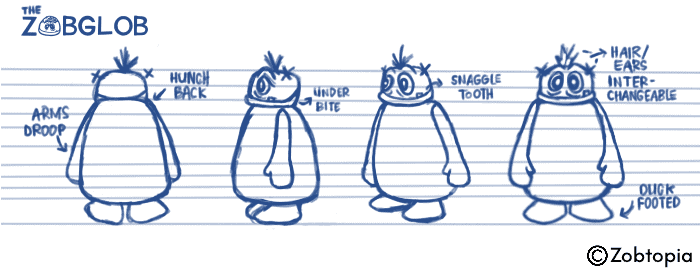
In relationship with the myriad scaffoldings embedded throughout our app—the gamified components, curricular progressions, and design elements that we hope you don’t even notice—we introduce our Zobglobs, the absolutely adorable (even if we do say so ?) customizable sidekicks who journey with our students every ztep along the way.
Emotions = Learning
Emotions significantly influence cognitive and metacognitive processes involved in learning and problem-solving in mathematics [1].
A meta-analysis of 223 studies published between 1992-2018 found an average effect size of -.28 between math anxiety and math performance [2]. That is, negative emotions lead to negative outcomes!
Conversely, positive emotions lead to positive outcomes. A meta-analysis of 28 studies found the implementation of positive emotional design improves learning outcomes, including retention (0.35), transfer (0.27), comprehension (0.29), intrinsic motivation (0.15), mental effort (0.11), liking/enjoyment (0.10), positive affect (0.09), and reduced perceived difficulty (−0.21) [3].
Designing for Emotions
Despite the relationship between emotions and learning, a systematic review of digital educational games found that learning apps do a really bad job supporting students emotionally. This is particularly true for students with special needs [4].
A systematic review and meta-analysis of digital games and game design in educational settings found that, while digital games have an overall effect size of .33 compared with nongame conditions, the actual effects of digital games on learning varies based on the quality of the game design, including emotional design mechanisms such as visuals and narrative characteristics [5].
Practically, this means that educational app design must be guided by research [6], including both the development of problem-solving capabilities, and—just as importantly—the fostering of positive emotions [1]. In other words, for math apps to be effective, they must include components that address both emotional aspects, such as math anxiety, interest, and motivation, as well as the more obvious cognitive components of solving math specific tasks [7].
To the need to incorporate emotional design into digital education games, a meta-analysis of 20 high-quality experimental and quasi-experimental studies comparing digital games to traditional teaching methods in mathematics, found that the effectiveness of digital games has more to do with the ways that digital games increase motivation and engagement than how they help students understand the practical value of the math skills being taught [8]. In short, digital games can be a valuable tool in mathematics education as long as they foster positive attitudes about math and support positive expectancy about students’ abilities to succeed at math—that is, as long as they support students’ emotional states through the mathematical challenges they encounter.
Enter Zobglobs
In just one of the ways we support students with positive emotional design, we have developed our Zobglobs as supportive companions to connect with and provide emotional support to our students.
Character design and narrative elements in apps play critical roles in attracting student’s attention and supporting educational objectives, including math success and socio-emotional learning [9]. Additionally, the perceived playfulness of digital learning environments is related to improved knowledge acquisition, engagement, and motivation [10].
In turn, we focused on the expression, shape, and color of our Zobglob companions, as each of these qualities contributes to students’ emotional responses within the learning environment [11] and impacts the development of cognitive skills [12]. Each companion has their own individual backstory, adding depth and personality to engage students in unique ways based on their own experiences and interests [13]
Ultimately, the success of a digital learning app depends on the extent to which student perspectives have been incorporated into the design of it [14]. In our case, the interviews and focus groups we conducted resulted in the development of characters that the students themselves said made they feel safe and confident—and that is exactly the way heroes should feel about their sidekicks.
Heroes in The Making
Math can be challenging. Math achievement can often seem out of reach. In math, finally getting it can feel great, but getting there can be really difficult.
On the journey from “this is impossible!” to “I get it!”, from frustration to celebration, our Zobglobs provide students with humor, connection, and support. They are companions to our students, remaining steadfastly at their sides through every trial and every triumph.
In education, we believe students are the heroes. And, we are honored to be invited to journey alongside them as they overcome every challenge standing between them and their success!
References
[1] Muis, K. R., Psaradellis, C., Lajoie, S. P., Di Leo, I., & Chevrier, M. (2015). The role of epistemic emotions in mathematics problem solving. Contemporary Educational Psychology, 42, 172-185. https://doi.org/10.1016/j.cedpsych.2015.06.003
[2] Barroso, C, Ganley, C. M., McGraw, A, L., Hart, G, S., & Daucourt, M. C. (2021). A meta-analysis of the relation between math anxiety and math achievement. Psychological Bulletin, 147(2), 134-168. http://dx.doi.org/10.1037/bul0000307
[3] Wong, R. M., & Adesope, O. O. (2021). Meta-analysis of emotional designs in multimedia learning: A replication and extension study. Educational Psychology Review, 33, 357-385. https://doi.org/10.1007/s10648-020-09545-x
[4] Griffith, S. F., Hagan, M. B., Heymann, P., Heflin, B. H., & Bagner, D. M. (2020). Apps as learning tools: a systematic review. Pediatrics, 145(1). https://doi.org/10.1542/peds.2019-1579
[5] Clark, D. B., Tanner-Smith, E. E., & Killingsworth, S. S. (2016). Digital games, design, and learning: A systematic review and meta-analysis. Review of educational research, 86(1), 79-122. https://doi.org/10.3102/0034654315582065
[6] Meyer, M., Zosh, J. M., McLaren, C., Robb, M., McCaffery, H., Golinkoff, R. M., ... & Radesky, J. (2021). How educational are “educational” apps for young children? App store content analysis using the Four Pillars of Learning framework. Journal of Children and Media, 15(4), 526-548. https://www.tandfonline.com/doi/abs/10.1080/17482798.2021.1882516
[7] Passolunghi, M. C., De Vita, C., & Pellizzoni, S. (2020). Math anxiety and math achievement: The effects of emotional and math strategy training. Developmental science, 23(6), e12964. https://doi.org/10.1111/desc.12964
[8] Fadda, D., Pellegrini, M., Vivanet, G., & Zandonella Callegher, C. (2022). Effects of digital games on student motivation in mathematics: A meta‐analysis in K‐12. Journal of Computer Assisted Learning, 38(1), 304-325. https://doi.org/10.1111/jcal.12618
[9] Behnamnia, N., Kamsin, A., Ismail, M. A. B., & Hayati, A. (2020). The effective components of creativity in digital game-based learning among young children: A case study. Children and Youth Services Review, 116, 105227. https://doi.org/10.1016/j.childyouth.2020.105227
[10] Georgiou, Y., & Ioannou, A. (2021). Developing, enacting and evaluating a learning experience design for technology-enhanced embodied learning in math classrooms. TechTrends, 65(1), 38-50. https://doi.org/10.1007/s11528-020-00543-y
[11] Plass, J. L., Homer, B. D., MacNamara, A., Ober, T., Rose, M. C., Pawar, S., ... & Olsen, A. (2020). Emotional design for digital games for learning: The effect of expression, color, shape, and dimensionality on the affective quality of game characters. Learning and instruction, 70, 101194. https://doi.org/10.1016/j.learninstruc.2019.01.005
[12] Rose, M. C., Ober, T. M., MacNamara, A. P., Olsen, A., Homer, B. D., & Plass, J. L. (2018, April). The effect of hot versus cool game character designs on the training of executive functions. In Annual meeting of the American Educational Research Association (pp. 13-17). https://www.researchgate.net/profile/Maya-Rose-3/publication/329222884_The_Effect_Of_Hot_Versus_Cool_Game_Character_Designs_On_The_Training_Of_Executive_Functions/links/5bfdc95a4585157b81729f44/The-Effect-Of-Hot-Versus-Cool-Game-Character-Designs-On-The-Training-Of-Executive-Functions.pdf
[13] Vanbecelaere, S., Van den Berghe, K., Cornillie, F., Sasanguie, D., Reynvoet, B., & Depaepe, F. (2020). The effects of two digital educational games on cognitive and non-cognitive math and reading outcomes. Computers & Education, 143, 103680. https://doi.org/10.1016/j.compedu.2019.103680
[14] Saleme, P., Dietrich, T., Pang, B., & Parkinson, J. (2021). Design of a digital game intervention to promote socio-emotional skills and prosocial behavior in children. Multimodal Technologies and Interaction, 5(10), 58. https://www.mdpi.com/2414-4088/5/10/58